
The short answer
Most AC problems come down to electrical parts, refrigerant issues, airflow restrictions or controls. We test each of those, show you what failed, and give written repair or replacement options so you can decide.
An air conditioner rarely fails without warning. Usually it hints first: a longer run time on a hot afternoon, a faint buzzing from the side yard, a vent that blows cool instead of cold. In the South Bay, where inland neighborhoods can bake for days while areas nearer the Bay stay comfortable, those hints tend to show up during the first real heat of the season. EliteAir Heating & Cooling repairs central air conditioners, heat pumps running in cooling mode and ductless systems in San Jose and the surrounding cities. We find the specific fault, explain it, and give you clear choices before touching anything.
Symptoms that call for a technician
Some problems are obvious, like a system that will not turn on at all. Others creep in gradually and are easy to ignore until the unit quits on the hottest day of the month. Pay attention if you notice any of the following.
- Air from the registers feels only slightly cooler than the room
- The outdoor unit hums or clicks but the fan blade does not spin
- Frost or ice forms on the copper line near the indoor coil
- Water collects around the furnace or air handler in the garage or closet
- The system turns on and off every few minutes
- A burning, musty or electrical smell comes through the vents
- The breaker trips shortly after the compressor starts
- Cooling bills rise while your thermostat habits stay the same
What our diagnostic covers
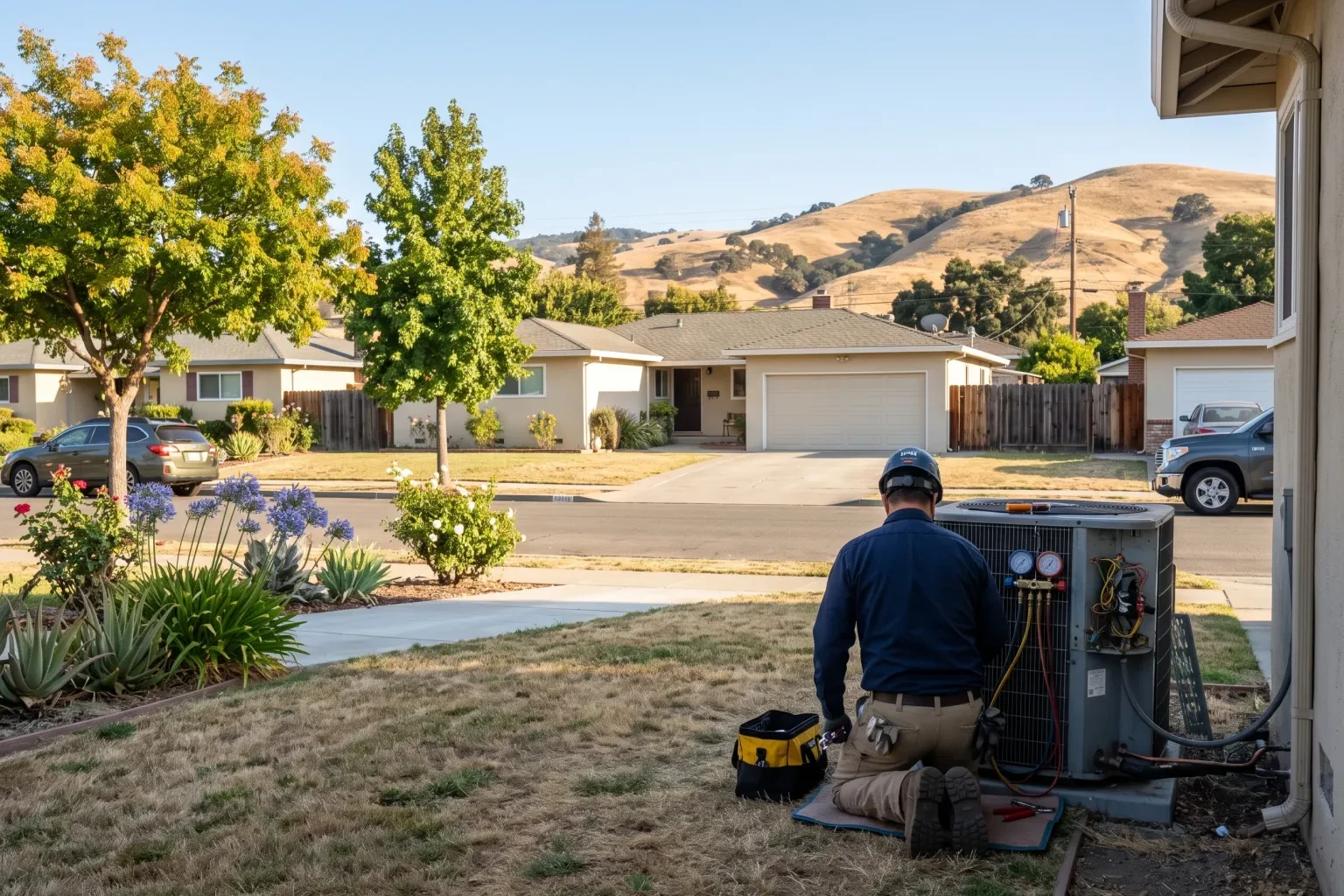
We work through the system in a set order so nothing is skipped. At the thermostat, we confirm settings, wiring and that it is actually calling for cooling. At the outdoor condenser, we inspect the contactor, capacitor, fan motor and compressor terminals, then measure voltage and amperage under load. A weak capacitor is one of the most common reasons a South Bay unit stops working during a warm spell, and it is quick to confirm with a meter.
Next comes the refrigerant side. We read operating pressures and line temperatures to calculate superheat and subcooling, which tells us whether the charge is correct or whether a leak, restriction or metering problem is present. If the numbers point to a leak, we discuss locating it rather than simply adding refrigerant and hoping.
Indoors, we check the evaporator coil, blower, filter and condensate drain. A clogged drain line or float switch can shut a system off as a safety measure, and a dirty coil or matted filter can starve the system of airflow until the coil freezes. Finally, we look at the supply and return ducts we can reach. In older San Jose homes, a disconnected attic run can dump cold air into the attic while the bedroom it serves stays warm.
Repair it or replace it
A repair is usually the sensible route when the system is in reasonable shape and the failed part is isolated: a capacitor, contactor, fan motor, drain line, thermostat or a reachable refrigerant leak. Those fixes can restore normal operation for many more seasons.
Replacement starts to make sense when the compressor has failed on an older system, when the coil is leaking in several places, or when the unit has needed a string of repairs in recent summers. Older equipment may also use a refrigerant that is costly and harder to source. In those cases we show you both paths. Some homeowners choose a heat pump as the replacement because it can handle both cooling and heating, which is worth considering given that Bay Area Air District rules will require gas furnaces manufactured from 2029 to meet a zero-NOx standard. Those rules do not force you to replace working equipment, though, so a sound furnace can stay in place.
If you are weighing replacement, keep in mind that the federal 25C credit no longer applies to installations after 2025. BayREN and local clean energy providers may have incentives available; we confirm current offers before including them in a quote.
What shapes the cost of a repair
We do not publish set figures, because the right number depends on what we find. Several factors move it up or down.
- Which component failed and whether it is a common or specialty part
- Refrigerant type, amount needed and whether a leak must be located and repaired
- Access to the equipment, such as a tight attic, crawlspace or rooftop unit
- Whether the system is a standard split, a heat pump or a ductless unit
- Related damage, such as a burned wire or corroded coil found during testing
- Time of the visit and how quickly parts can be obtained
How an AC repair visit unfolds
When you contact us, we ask what the system is doing, where the indoor and outdoor units sit, and roughly how old the equipment is. That helps the technician bring likely parts. We give you an arrival window and let you know if it changes.
On arrival, the technician listens to your description, then runs the diagnostic described above. Before any repair, you get a written explanation of the problem and your options. Once you approve, the work is completed, the system is run through a full cooling cycle, and readings are taken again to confirm it is performing correctly. We clean up and go over anything you should watch for in the coming weeks.